Mech discourages working at heights unless absolutely necessary, and all workers must be adequately trained prior to performing the work. These procedures provide a brief summary of WorkSafeBC Fall Protection and Ladder Safety guidelines.
Fall Protection
Fall protection must be used when working at an unsafe working height. According to WorkSafe BC, an unsafe working height is a height
where a fall of 3 m (10 ft) or more may occur, or
where a fall from a height of less than 3m involves risk of injury greater than the risk of injury from the impact on a flat surface.
Ladders are not an alternative to fall protection; fall protection must be used when working on ladders at unsafe working heights. The following provide guidelines for ladder use.
WorksafeBC imposes some restrictions on ladder use:
If work cannot be done from a ladder without hazard to a worker, a work platform must be provided.
A worker must not carry up or down a ladder, heavy or bulky objects or any other objects which may make ascent or descent unsafe.
They also provide requirements for specific situations:
A portable ladder must
be placed on a firm and level surface, and
be of sufficient length to enable the safe performance of the work activity while being used.
A portable non-self-supporting ladder must,
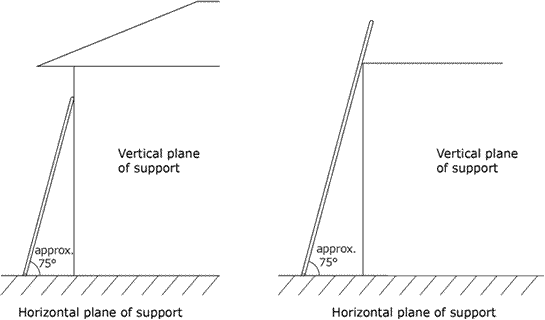
as shown in Figure 13-1, be positioned so that the ladder is leaning against the vertical plane of support at an approximate angle of 75° when measured from the horizontal plane of support,
if the ladder provides access to or egress from an upper landing,
project approximately 1 m (3 ft) above the upper landing, and
be sufficiently secured in place to ensure the stability of the ladder during access to or egress from the upper landing, and
if the ladder is not already secured in accordance with paragraph (b)(ii), be sufficiently secured in place to ensure the stability of the ladder during use if conditions exist that are likely to cause the ladder to be unstable.